A federal customer is ready to procure. The architecture is not.
FedRAMP does not authorize companies. It authorizes a cloud service offering, at a specific impact level, inside a specific boundary. The output is an Authority to Operate (ATO) for that offering, not a certificate the company carries around. Teams that treat it as a documentation exercise write a System Security Plan describing an environment that does not exist, and the gap surfaces the moment a 3PAO starts testing.
The pattern repeats across engagements. Engineering understands the product, the compliance lead knows what 800-53 asks for, and the architecture in between was built for speed before anyone drew a boundary. By the time a federal deal is live, the remediation list is longer than the original build.
Stonebridge defines the authorization boundary first, then writes the Terraform. Controls are enforced in the infrastructure, and the control narrative is generated from what actually runs, so the SSP and the system stay in agreement.
NIST SP 800-53 families the infrastructure has to carry
FedRAMP Moderate baselines to roughly 320 controls and High to roughly 410, drawn from NIST SP 800-53 Rev 5. Most are inherited from the cloud provider or satisfied by organizational policy. The subset the architecture itself must satisfy is smaller, and it is where assessments actually fail.
The families the environment most directly implements:
- ACAccess Control. Identity federation, least-privilege roles, session management, and separation of duties enforced in IAM rather than described in policy.
- AUAudit and Accountability. Centralized, tamper-evident logging in an account engineers cannot modify, with defined retention and time synchronization.
- CMConfiguration Management. Baseline configuration in Terraform, drift detection on production state, and policy gates that reject non-conforming changes at plan time.
- IAIdentification and Authentication. Phishing-resistant MFA, credential lifecycle, and no shared or long-lived static keys inside the boundary.
- SCSystem and Communications Protection. Boundary protection, FIPS-validated cryptography, and encryption in transit and at rest with customer-managed keys.
- SISystem and Information Integrity. Vulnerability scanning on the FedRAMP cadence, flaw remediation tracked to POA&M, and signed artifacts through the deploy path.
Draw the boundary first. Then write Terraform.
The architecture that survives a 3PAO assessment rests on four decisions. Implementation differs across AWS, GovCloud, GCP, and Azure Government; the architecture does not.
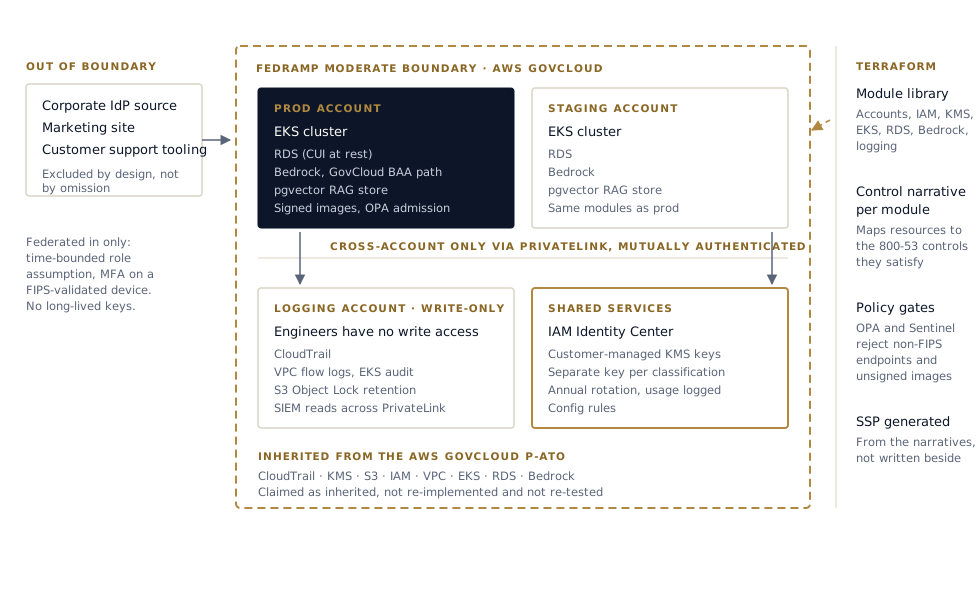
Principle 1: Define the authorization boundary before any code
The boundary is every component that stores, processes, or transmits federal data, plus everything that can affect their security. This is the highest-leverage decision in the entire program: control count, evidence volume, assessment cost, and continuous monitoring burden all scale with what falls inside it. We draw it, get agreement on it, and only then start building.
Principle 2: Account-level isolation with explicit interconnections
In-boundary workloads live in dedicated accounts, projects, or subscriptions, separated from corporate and development environments. Every crossing of the boundary is an explicit, documented, mutually-authenticated interconnection. External services either come inside the boundary or are documented as leveraged authorizations, and there is no third option an assessor will accept.
Principle 3: FIPS-validated cryptography with customer-managed keys
Encryption in transit and at rest using FIPS 140-validated modules, with customer-managed keys, automated rotation, and logged key usage. This is a frequent finding source because the default configuration of many managed services is not FIPS-validated even when it is encrypted.
Principle 4: Evidence as a system output, not a deliverable
Every account, service, and identity event ships to a logging account engineers cannot modify, with retention locks preventing tampering. Each Terraform module ships with a control narrative mapping its resources to the 800-53 controls it satisfies, so the SSP is generated from the infrastructure rather than written alongside it and drifting.
Six artifacts your assessor will ask for
A FedRAMP Cloud Build produces a defined set of deliverables, each mapped to 800-53 controls and ready to drop into the authorization package.
Authorization boundary
- Boundary diagram
- Data flow diagrams
- Network topology
- Interconnection inventory
Infrastructure as code
- Terraform modules per control family
- OPA / Sentinel policy gates
- Drift detection wired to alerting
- State backend inside the boundary
Identity & access
- IdP federation, phishing-resistant MFA
- Role catalog with least-privilege scopes
- Access review automation
- Break-glass procedure
Cryptography & keys
- FIPS-validated crypto inventory
- Customer-managed key topology
- Automated rotation
- Key usage audit logging
Logging & ConMon
- Immutable logging account
- Retention locks
- Scanning on FedRAMP cadence
- Continuous monitoring plan
Control documentation
- SSP-ready control narratives
- Customer responsibility matrix
- POA&M starting position
- CMMC / IL4 crosswalk
Five patterns that stall authorizations
The same failures show up repeatedly when teams pursue FedRAMP without architectural help.
A boundary drawn to include everything
The fastest way to double an assessment is to leave the boundary vague so it swallows corporate IT, developer laptops, and every SaaS tool in use. Every component inside inherits the full control set. We scope the boundary deliberately and document what sits outside it and why.
Unauthorized services inside the boundary
The IaC happily provisions a managed service that has no FedRAMP authorization at your impact level. It works, it ships, and it becomes a finding. Policy gates that reject unauthorized services at plan time prevent the silent boundary breach.
Encrypted, but not FIPS-validated
Teams confirm encryption is on and move along. FedRAMP requires FIPS 140-validated cryptographic modules, and several managed services default to configurations that are encrypted without being validated. This is one of the most common late-stage findings.
An SSP that describes a different system
The narrative is written once, the infrastructure keeps changing, and by assessment the document describes a system that no longer exists. Generating narratives from the Terraform keeps the two in agreement by construction.
Continuous monitoring treated as a post-ATO problem
Monthly scanning, POA&M management, and significant-change reporting are ongoing obligations. Teams that build without them discover after authorization that they have no operational capacity to keep it, and the ATO becomes the hardest part to hold rather than to get.
Two ways to engage. Fixed scope, fixed price.
Most programs start with the assessment. It produces a boundary definition and a written roadmap that contracting can price against, and it frequently converts into the build. Teams with a federal deal already in motion come straight to the build.
FedRAMP Readiness Assessment
Two-week assessment of your cloud environment against the NIST SP 800-53 baseline at your target impact level. Produces a boundary definition, control gap map, and prioritized remediation roadmap with effort estimates.
- Authorization boundary definition
- 800-53 control gap map
- Prioritized remediation roadmap
- Effort estimates per finding
- Priceable by contracting
FedRAMP Cloud Build
Hands-on engagement to architect and ship a FedRAMP-aligned environment. Authorization boundary, Terraform control modules, identity, cryptography, logging, and SSP-ready narratives, handed to your team with runbooks.
- Production-ready boundary
- Terraform modules per control family
- Immutable logging architecture
- SSP-ready control narratives
- 30-day post-handoff support
A representative engagement
Client profile: AI SaaS vendor with a federal customer ready to procure and an architecture that could not yet support authorization. Target was FedRAMP Moderate on a timeline set by the customer, not by the vendor.
FedRAMP Moderate architecture, ready for 3PAO assessment
A federal customer was ready to buy. The platform had been built for commercial speed, with no boundary drawn, services provisioned without regard to authorization status, and no control documentation. The gap between the product and a defensible package was the whole engagement.
We drew the authorization boundary before writing any Terraform, then built a module library where every module ships with a control narrative file mapping its resources to the 800-53 controls it satisfies. Identity, logging, and the deploy pipeline were rebuilt inside the boundary, and the SSP narrative was generated from the infrastructure rather than written alongside it.
on first-party assessment
the customer deadline
after boundary lock
What federal and defense engineering leaders say after working with Stonebridge
"Hired Stonebridge Tech Solutions for a FedRAMP project on GCP and he nailed it, the architecture aligned cleanly with Moderate controls and the documentation was audit-ready. Rare to find someone with both deep GCP chops and real FedRAMP experience."
"Lucas came in, assessed our environment, and got to work without needing his hand held. He optimized our deployment pipelines, improved our security posture, and identified cost savings. Everything was well-documented and delivered on schedule."
"Stonebridge's cloud architecture work has been the cleanest engineering remediation we've ever received. The Terraform was usable, the control narratives were ready for assessment, and the runbooks meant our team could actually own the environment after handoff."