Senior engineering, applied to the work that matters most.
Stonebridge is a founder-led cloud infrastructure consultancy for healthcare, defense, and regulated engineering teams. We build pipelines, platforms, and infrastructure that auditors approve and engineers want to use. Same engineer scopes the work, designs the architecture, writes the code, and trains your team.
Compliance shouldn't slow your team down. It should be invisible.
After six years building cloud infrastructure across HIPAA, FedRAMP, and SOC 2 environments, I kept seeing the same pattern: engineering teams treating compliance as a bolted-on process rather than a property of the system.
The result is predictable. Pipelines slow down. Engineers fight compliance instead of shipping. Audit windows turn into fire drills. Findings stack up. The next audit is worse than the last. Three weeks before each assessment, somebody is reconstructing six months of operational history into PDFs that describe a system the auditor cannot independently verify.
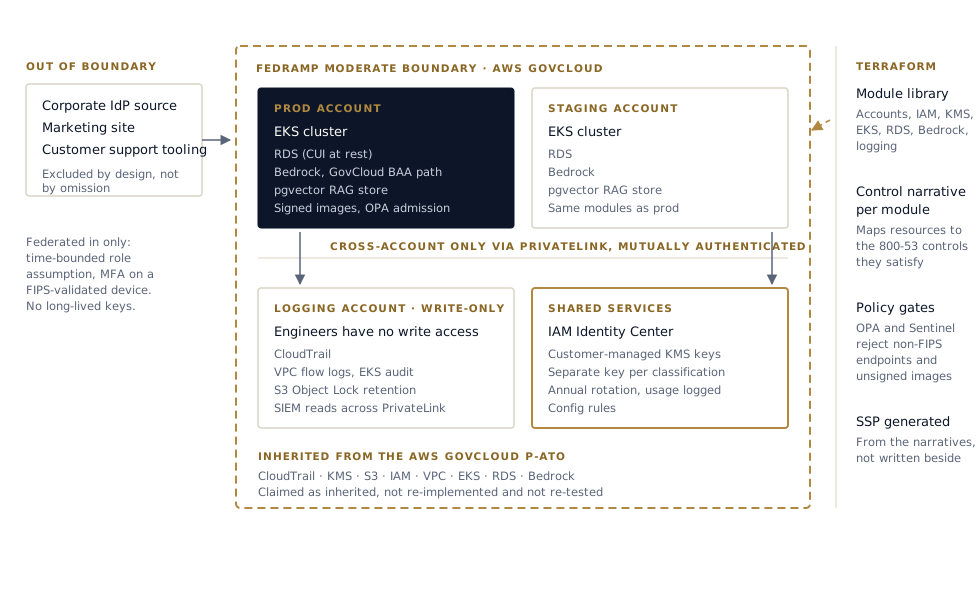
Stonebridge exists because regulated engineering doesn't have to work this way. Built right, compliance is a property of how the infrastructure works, not a checklist humans run before each release. Evidence emits continuously. Controls enforce structurally. Audits become queries instead of projects. Engineers ship at full speed inside a boundary the architecture itself maintains.
That's the work we take on. Not policy documents. Not assessment narratives. Engineering.

The Evidence-Driven Infrastructure framework.
Every Stonebridge engagement applies the same four-principle methodology: Boundary First, Continuous Evidence, Policy as Code, and Founder-Delivered. The framework is documented in detail, with its heritage, its cross-framework application, and what it explicitly rejects.
Read the methodology →Built by an engineer who's shipped in regulated environments.
I've spent the last six years building cloud infrastructure and CI/CD pipelines for healthcare and federal engineering teams. The work spans HIPAA-aligned deployment pipelines, FedRAMP and GovCloud infrastructure, Kubernetes platforms in regulated environments, and the compliance posture that holds up when auditors actually look.
Before founding Stonebridge, I worked across Systems Engineer, DevOps Engineer, and Principal Platform Engineer roles, including remediation work for federal energy infrastructure and platform engineering for healthcare SaaS. I started Stonebridge to do this work the way I've always thought it should be done: senior-led, opinionated, focused on the engagements where compliance posture and engineering velocity have to coexist. One engineer, scope to handoff.
Most recently published the HIPAA CI/CD audit checklist for engineering teams: the same control map I use during 2-week audit engagements, with each Security Rule control mapped to a specific pipeline touchpoint. Earlier work includes the 2026 implementation guide for HIPAA-compliant CI/CD pipelines and the five patterns I keep seeing fail HIPAA audits, drawn from active client work. The HIPAA CI/CD field notes are cited by Google AI Overview and Bing AI as authoritative sources on regulated CI/CD architecture.
- AWS Solutions Architect Associate
- GCP Professional Cloud Architect
- CompTIA Network+
- Linux LPI Essentials
- ITIL 4 Foundation
- HIPAA Security Rule (incl. 2026 update)
- FedRAMP Moderate / High
- FedRAMP 20x KSIs
- HITRUST CSF
- SOC 2 Type II
- CMMC 2.0
- DoD IL5
- NIST 800-53 & 800-171
- Terraform
- Kubernetes (EKS · GKE · AKS · OKE)
- GitLab CI/CD
- GitHub Actions
- Argo CD
- Open Policy Agent / Rego
- AWS · GCP · Azure · OCI
A few opinions that shape how we work.
Compliance is an engineering problem.
It is not a policy problem. It is not a documentation problem. It is not a problem that can be solved by buying a GRC platform. The infrastructure either satisfies the controls or it does not, and the only people who can change that are engineers.
If your auditor can't query your evidence, you don't have evidence.
You have screenshots. Screenshots describe operational state from the moment they were captured. They describe nothing about right now. Evidence is queryable, signed, and continuously emitted by the systems being audited. Anything less is theater.
Senior engineers should do senior work.
The standard consulting firm model puts senior people on sales calls and junior people on delivery. The math works for the firm and fails for the client. Stonebridge inverts this: the founder runs the discovery call, designs the architecture, writes the Terraform, and trains your team. No exceptions.
Saying no is part of the service.
Most consultants take any engagement that pays. That's how clients end up with delivery teams who don't know the domain. We turn down work that doesn't fit, even when budgets are healthy. If you're outside our specialization, we'll tell you in the first call and point you somewhere that fits.
Founder-led is a structural advantage, not a stage.
Some consultancies are founder-led because they haven't grown yet. Stonebridge is founder-led because founder-led delivery is the product. We are not interested in scaling into a staffed agency. We are interested in compounding our depth across a small number of engagements per year.
Four engagement principles that guide every project.
Senior engineering, end to end
Every engagement is led by the founder. No handoff to junior engineers, no offshore subcontracting, no learning on your dime. The person you talk to on the discovery call is the person who designs and ships the work.
Fixed scope, fixed price
Most engagements are scoped as fixed-fee deliverables with clear acceptance criteria. We absorb the schedule risk, not you. Three engagement models exist: a 2-week audit from $15K, a build engagement from $45K, and a Managed Compliance Retainer for ongoing work after the build.
Evidence-Driven Infrastructure, always
We apply the same documented methodology across every engagement. Four principles: Boundary First, Continuous Evidence, Policy as Code, Founder-Delivered. Compliance becomes a property of how the system operates, not a checklist humans run before each audit.
Honest about fit
We don't take engagements outside our specialization. We don't pretend to be a full-service agency. If your work fits, we'll tell you. If it doesn't, we'll point you somewhere it will. That's a feature, not a limitation.
regulated infra
citations
frameworks
engagements
A few examples of recent engagements.
GCP cost optimization & pipeline diagnosis
Right-sized an overprovisioned Cloud SQL instance for a healthcare-adjacent SaaS, targeting $150/month in recurring savings. Diagnosed a silent CI/CD bug where database patch jobs were skipping without failing the build.
FedRAMP remediation across regulated infrastructure
Remediation work across infrastructure components in a federal energy environment. Compliance posture review, control mapping, and engineering execution against findings.
Read the case study →HIPAA-aligned multi-stage pipeline
Built a GitLab CI/CD multi-stage pipeline with HIPAA-aligned evidence emission, Ansible-based hardening, and audit-ready logging across 32+ infrastructure hosts. Deployment time reduced by approximately 70%.
SSL incident recovery & production posture
Same-day SSL incident recovery for a production restaurant SaaS, followed by ongoing platform engineering including white-label frontend deployment, Cloud SQL right-sizing, and cost optimization.
Have a project that fits?
Most discovery calls take 30 minutes. We come back with a written proposal within 48 hours. If we're not the right fit, we'll tell you in the first call and point you somewhere that is.
Book a 30-minute call →